Using child restraints on aircraft
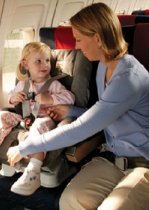
When you fly with a child under the age of two, you have a choice. Your child can ride on your lap for free, or you can buy a ticket and put your child in a seat. Although it is legal in the US to carry children under two on your lap, the FAA strongly recommends that all children who fly, regardless of their age, be protected by an approved child restraint system (CRS) or child restraint device that is appropriate to the child's size and weight. Proper use of an approved child restraint system enhances child safety in the event of an accident, and also for the much more common problem of aircraft turbulence. A CRS also provides protection for a child during turbulence.
A CRS is a hard-backed child safety seat that is approved by the government for use in both motor vehicles and aircraft.
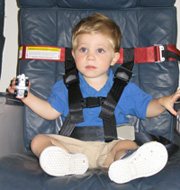
A child safety device is an FAA-approved alternative to using a hard-backed seat and is approved only for use on aircraft. It is not approved for use in motor vehicles.
Approved Child Restraint Systems
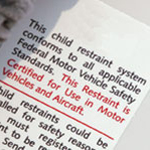
- Make sure your CRS is government approved and has "This restraint is certified for use in motor vehicles and aircraft" printed on it. Otherwise, you may be asked to check the CRS as baggage.
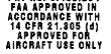
- Make sure a child safety device is approved and has "FAA Approved in Accordance with 14CFR 21.305(d), Approved for Aircraft Use Only" on it.
- Arrange for your airline to help you if you need help making a connecting flight. Carrying a CRS, a child, and luggage through a busy airport can be challenging.
- The FAA recommends that a child weighing less than 20 pounds (9.1 kilos) use a rear-facing CRS, that one weighing from 20 to 40 pounds (9.1 to 18.1 kilos) use a forward-facing CRS, and that those over 40 pounds (18.1 kilos) use an airplane seat belt
Other restraint systems
While booster seats and harness vests enhance safety in vehicles, FAA prohibits passengers from bringing these types of devices on airplanes for use during taxi, takeoff and landing. These devices should be checked as baggage. Also, supplemental lap restraints or "belly belts" are not approved for use in both airplanes and vehicles in the United States.
The FAA has also approved the AmSafe Aviation CARES harness type restraint that uses an additional belt and shoulder harness that goes around the seat back and attaches to the passenger lap belt to provide restraint for the upper part of the body. It is designed for children weighing between 22 and 44 pounds.
Before you Fly
Check with the airline to find their busiest days and times. By avoiding these times you are more likely to be on a flight with an empty seat next to a parent. In many cases airlines will allow you to seat your child under two years of age in a child restraint in the empty seat at no extra charge. Ask your airline for its policy regarding an empty seat.
Ask the airline if they offer a discounted fare for a child traveling in a CRS. When you buy a ticket (discounted or full fare) for your child, you are guaranteed that they will have a seat and that you will be able to use the CRS.
If you purchase a ticket for your child, reserve adjoining seats. A CRS should be placed in a window seat so it will not block the escape path in an emergency. A CRS may not be placed an exit row.
Check the width of your CRS. While child seats vary in width, a CRS no wider than 16 inches (40.6 cm) should fit in most coach seats. A CRS wider than 16 inches (40.6 cm) is unlikely to fit. Even if the armrests are moved out of the way, a wide CRS will not fit properly into the frame of the aircraft seat.
If you need to change planes to make a connecting flight, request that the airline arrange for assistance in your connecting city.
Related Resources
Top 10 Safety Tips for Traveling With Children
FAA consumer information hotline
FAA brochure on the safe use of child seats
Child Travel Health Advice from the Centers for Disease Control
FAA Regulation 121.311 concerning child seat use
Sources: Fly Smart Air Traveler's Checklist, Federal Aviation Administration
http://airsafe.com/kidsafe/chldseat.htm -- Revised: 13 August 2010